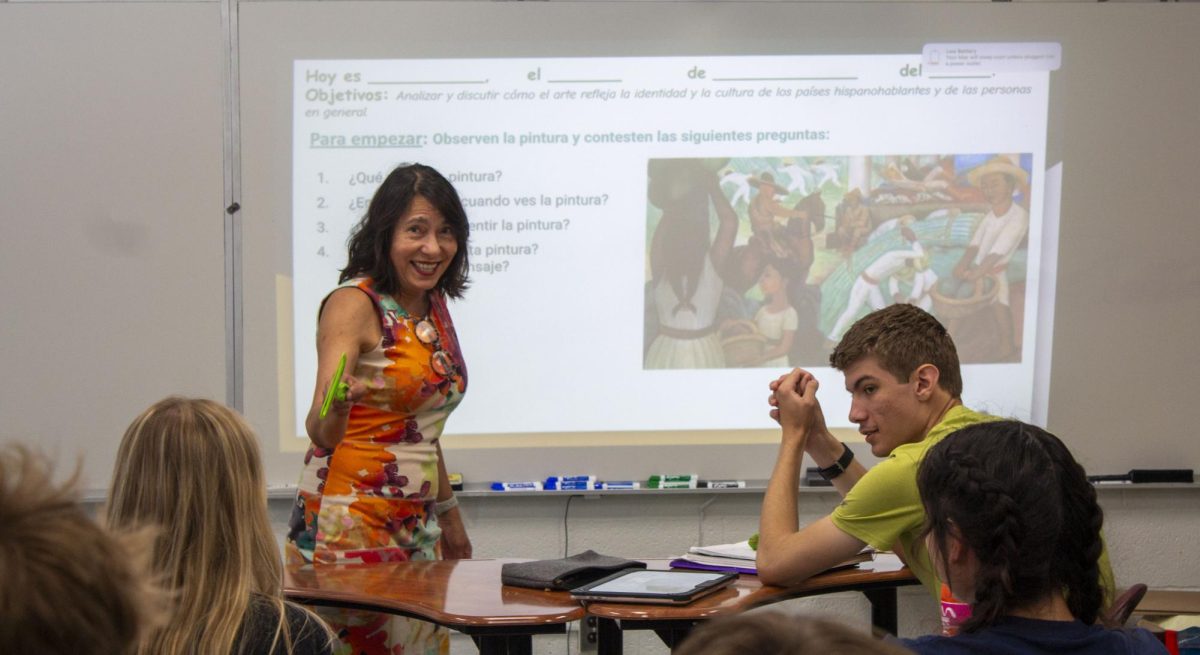
On Wednesday, March 4, 2026, around 130 students from Pascack Valley High School’s AP Government and Politics classes, U.S. II classes, and This Week in Politics club attended a lecture on Iran. During the lecture, organized by Jeff Jasper and Kenneth Sarajian, Dr. Christopher Guinta, who has a master’s degree in Middle Eastern History, spoke about the many aspects of the developing conflict in Iran and what the possibilities were for what could happen. Students were encouraged to ask questions and voice their concerns to get a better understanding of the history in the region and current events.
On Feb. 28, 2026, the United States and Israel fired air strikes at Iran, killing the Supreme Leader Ayatollah Ali Khamenei and top security officials. It is also speculated that the US was responsible for an attack on an all-girls school, killing many civilians. More recently, Iran has placed the late Ayatollah’s son, Mojtaba Khamenei, as the new Supreme Leader, devastating hopes of a more progressive leader.
During the discussion, students from all classes were invited to ask questions and participate in the conversation. Topics such as the humanitarian aspect, moves the United States is likely to make, and what may happen regarding power in Iran were all points of discussion.
Mr. Guinta noted that the conflict is a very important topic for students to learn about, saying, “The Middle East in general is going to be a place where the United States, as well as some of the European powers, are going to be embroiled for the next 100 years. There’s a lot going on there… It’s a very important part of the world, and it’s a part of the world where I know we’re going to be for the foreseeable future.”
In a separate interview, Guinta relayed the history of conflict between the United States and Iran starting in the 1950s, when the United States overthrew freely elected Prime Minister Mohammad Mosaddegh. After that, Guinta explained, “We put the Shah in place; he basically wanted to nationalize Iran’s oil resources and give more back to the people by doing that.”
The Shah stayed in power until 1979, the year the Islamic revolution began.
“Ayatollah Khamani took over, and since then, for the last 47 years, it’s been that same regime leading the country,” Guinta said.
Originally, President Donald Trump mentioned that he would be willing to speak with and put the Shah’s son, who has lived in Canada most of his life, into temporary power until the country was stable enough to vote in an election. However, on Mar. 8, a new Supreme Leader, the son of the late Ayatollah Mojtaba Khamenei, came into power. Because he is the son of the last leader, there is little hope for a more progressive regime.
The United States has many issues with Iran, with a large one being its nuclear program, which they have had for 20 years, according to Guinta. The United States attacked three of Iran’s major nuclear sites in June of 2025, when Trump said that the sites had been “obliterated.” However, there are more recent reports with updated intelligence that the sites have not been completely destroyed.
In addition, Guinta explained there is a humanitarian crisis as well, since the Iranian government killed thousands of protesters who were protesting various societal problems beginning on Dec. 28. Guinta said, “They [the Iranian Government] did kill between 32,000 and 47,000 of their own people during the protests,” making the regime a substantial threat to people living in Iran.
The issue that is affecting Americans the most right now is oil. The Strait of Hormuz, located in the South of Iran, has been shut down due to the ongoing conflict.
“Iran has been sending cheap oil to Russia as well as China. I think the hope is that if we had a regime that was more pro-American, that that oil would come our way,” Guinta said.
20% of global oil goes through the Strait, and as it has been shut down since the conflict began, barely any oil has passed through, sending gas prices through the roof to a national average of $3.598, around 70 cents higher than last month’s average. The new supreme leader has declared that the Strait will remain closed as a leverage tactic.
Another focus for the U.S. right now, Guinta says, is cutting down drones that Iran is building for Russia to send into Ukraine, and getting rid of Iran’s ballistic missile supply.
“From what we’ve been told at least, we’ve cut the ballistic missile supply by around 90% and the drones by a significant amount too,” Guinta explained.
This lecture was a way for PV students to get involved and to discuss what is currently going on around the world in politics. It is crucial that students are able to understand what is going on in the world and to be able to make personal judgements.
To come to an end, Jasper wanted students to leave the room knowing how to have conversations about political topics and to be conscious about the world events currently going on.
“It’s so often that controversial issues are sidestepped… You can’t say that we’re going to put on blinders and pretend that the world doesn’t exist outside of the wonderful Pascack Valley bubble,” Jasper noted.